

 Back to Home

Mileva Einstein: The Researcher
The remarkable journey of a pioneer in theoretical physics at the turn of the 20th century.
A Brilliant Student
Mileva Marić was born on December 19, 1875 in Titel, then part of the Austro-Hungarian Empire (now in Serbia), into a family that valued education. From an early age she stood out for exceptional intellectual abilities, particularly in mathematics and the sciences. In a social context where women were rarely encouraged to pursue advanced scientific studies, Mileva had to overcome many obstacles to access higher education.
Her school career was marked by excellent results, notably in disciplines considered masculine at the end of the 19th century. Thanks to her perseverance and the support of progressive teachers, she managed to enter prestigious institutions—an exceptional achievement for a woman of her time.
In 1896, Mileva Marić became one of the first women admitted to the Zurich Polytechnic (now ETH Zurich) to study physics and mathematics. She was the only woman enrolled in the physics section, studying in an academic environment largely dominated by men. This exposed her to constant pressure, but she stood out for her seriousness, scientific rigor, and analytical ability.
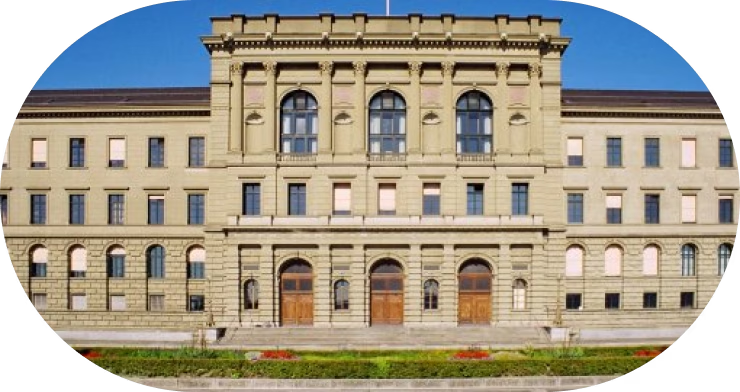
During her studies, Mileva specialized in complex fields such as theoretical physics and advanced mathematics. She was noted for a methodical approach and a deep understanding of scientific concepts—qualities recognized by some of her peers and professors. Nevertheless, she faced institutional and personal difficulties that hindered her academic recognition.
Mileva Marić's university career illustrates both her undeniable talent and the limitations imposed on women scientists at the end of the 19th century. Her commitment to science and her place within an institution as prestigious as ETH Zurich make her a significant figure in the history of women in science, far beyond her role as a student.

Education
- Zagreb High School (1890-1894)
- Zurich Polytechnic (1896-1900)
- Studies in theoretical physics
- Advanced mathematics
Collaboration with Albert Einstein
The intellectual relationship between Mileva Marić and Albert Einstein went far beyond a simple personal bond. Their correspondence, preserved in part, reveals a genuine dynamic of scientific work. In several letters addressed to Mileva, Albert Einstein used expressions such as "our work" or "our paper" to refer to their joint research, particularly in theoretical physics. These formulations suggest an active collaboration based on exchanges of ideas, in-depth scientific discussions, and shared intellectual effort.
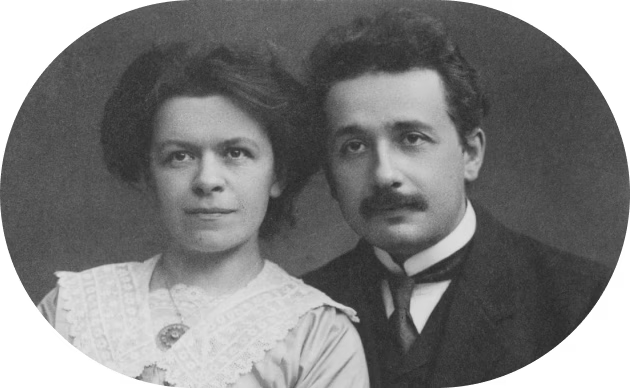
This collaboration reached its peak in 1905, a year now known as the Annus Mirabilis. During this exceptional period, Albert Einstein published several papers that transformed the foundations of modern physics. These include work on the photoelectric effect, Brownian motion, special relativity, and the famous equation E = mc², which establishes the equivalence of mass and energy. These advances marked a decisive turning point in the history of science.
Yet despite indications of collaborative work, only Albert Einstein's name appears on the 1905 scientific publications. At the time, institutional recognition of women scientists was extremely limited, and it was not uncommon for their contributions to be minimized or entirely made invisible. Mileva Marić, although trained at a high academic level in mathematics and physics, received no official recognition for any involvement she may have had in these researches.
This lack of recognition raises broader questions about the place of women in the history of science and how certain contributions have been erased or underestimated. Today, Mileva Marić is increasingly studied not only for her connection to Albert Einstein but also as a symbol of the obstacles faced by women scientists in the early 20th century.

Research Areas
- Special relativity
- Thermodynamics
- Thermal conductivity
- Theoretical physics
Also read
Women in Science in Literature
Space-Time & Speed of Light