

 Back to Home

Women in Science in Literature
∑∫∂∇π∞
Literary Invisibilization
For centuries, women's contributions to science have been widely minimized or even erased from written accounts. This invisibilization is not limited to academic publications but also extends to popular literature, school textbooks, scientific biographies, and major historical narratives that shape collective memory. As a result, the history of science presented to the public has long given the impression that major discoveries were almost exclusively the work of men.
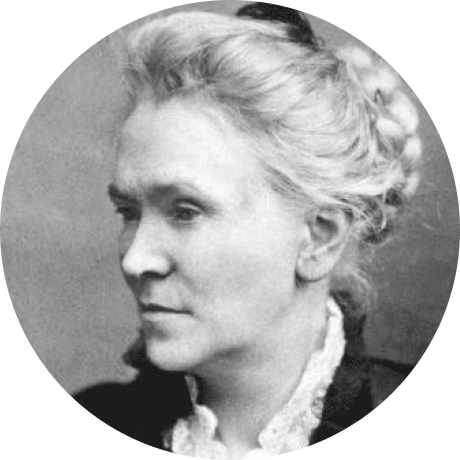
In classical scientific literature, women are rarely mentioned as central actors in research. When they do appear, it is often in secondary roles: laboratory assistants, discreet collaborators, or wives of recognized scientists. Their intellectual contribution is then presented as support rather than as a standalone scientific contribution, even when their work is essential to the discoveries made. This biased representation reinforces the idea that scientific genius is predominantly male.
Textbooks have long perpetuated this narrow view. By highlighting a limited number of male figures, they have left little room for women scientists, depriving students of female role models in science and technology. This absence is significant: it shapes perceptions of social roles and can discourage future careers, especially among young girls who struggle to envision themselves in scientific professions.
Popular literature—biographies, historical novels, and popular science essays—has also contributed to this invisibilization. Women are frequently defined by their relationship to a famous man rather than by their own work. This narrative treatment reduces their scientific identity and obscures the complexity of their paths, which are marked by social, institutional, and cultural constraints.
Today, many researchers, historians, and authors work to correct these omissions by revisiting archives, publishing new biographies, and including more female figures in educational curricula. This critical re-examination of scientific and historical literature does not aim to rewrite history but to make it more complete and faithful to the reality of scientific contributions, finally recognizing the essential role women have played in the development of knowledge.
Mechanisms of Erasure
The erasure of women scientists from literature and the history of science is not accidental but rests on several systematic mechanisms embedded in long-standing institutional, cultural, and social practices. These mechanisms have contributed to making their work invisible and to minimizing their role in major scientific advances.
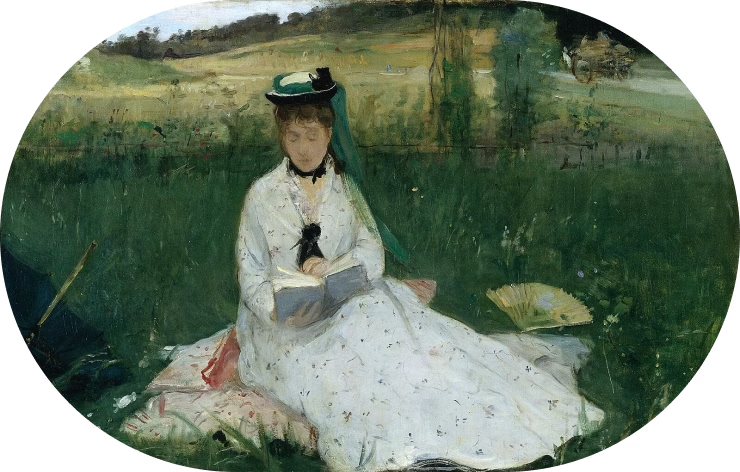
The first of these mechanisms involves attributing women's contributions to male colleagues, particularly husbands, supervisors, or senior collaborators. This phenomenon is now referred to as the "Matilda effect," named after Matilda Joslyn Gage, who identified this bias as early as 1870. In many cases, women's work is published under a male name or presented as the result of collective work for which only the man receives credit. This practice was long facilitated by the exclusion of women from official academic positions and learned societies.
A second mechanism lies in how women appear in scientific texts and historical narratives. When mentioned, they are frequently portrayed in roles considered secondary or technical: laboratory assistants, "computers," scientific secretaries, or simple collaborators. These labels reduce their contribution to executive assistance, even when they may have originated hypotheses, methods, or theoretical interpretations. Their expertise and intellectual leadership are thus systematically downplayed.
A third mechanism concerns institutional recognition. Women were long excluded from access to degrees, university positions, funding, and scientific awards. This lack of official recognition directly led to their gradual disappearance from archives and bibliographic references. Without titles, positions, and honors, their work is more easily forgotten or attributed to others.
Finally, the erasure continues through the transmission of knowledge. Textbooks, popular science books, and historical narratives have often adopted simplified versions of the history of science centered on a few male figures presented as isolated geniuses. This narrative construction leaves little room for collaborations and erases women's contributions, helping to reproduce these biases across generations.
Timeline
Women scientists whose contributions were attributed to men
Mileva Einstein
Special relativity
Lise Meitner
Nuclear fission
Rosalind Franklin
DNA structure
Chien-Shiung Wu
Parity in physics
Jocelyn Bell Burnell
Pulsars
Also read
The Matilda Effect
Space-Time, Jean-Paul Auffray